
Overview
Overview
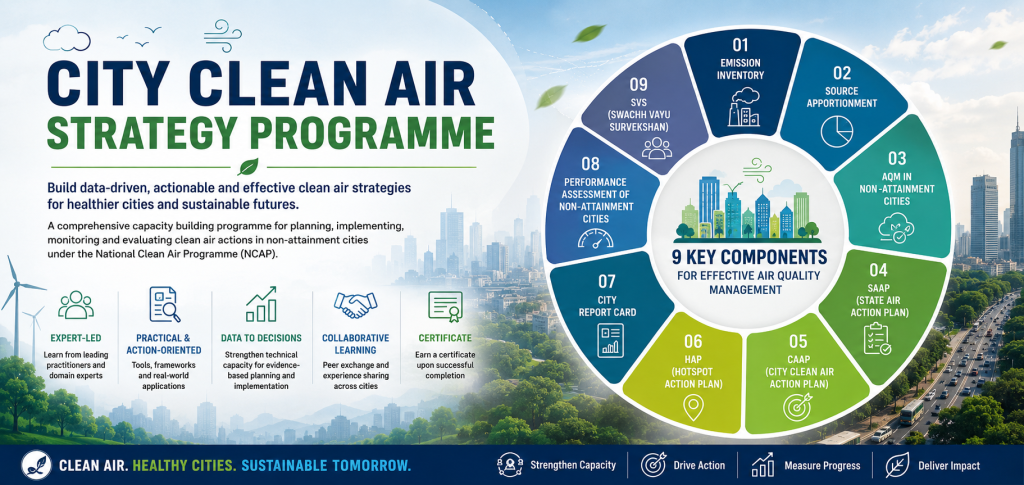
The City Clean Air Strategy Programme is designed to strengthen the technical and institutional capacities of officials and stakeholders involved in planning, implementation, monitoring, and evaluation of clean air interventions under the National Clean Air Programme (NCAP). The programme provides a comprehensive understanding of the key components required for effective city-level air quality management, including emission inventory, source apportionment, city action planning, hotspot management, monitoring systems, and performance assessment frameworks.
The course combines technical concepts, implementation approaches, and practical case studies to help participants develop actionable and data driven clean air strategies for non-attainment cities. The programme also familiarises participants with national frameworks such as Swachh Vayu Survekshan (SVS), city report cards, and performance assessment mechanisms for NCAP cities.
The programme covers the following thematic areas:
- Emission Inventory (EI)
- Source Apportionment (SA)
- Air Quality Management (AQM) in Non-attainment Cities
- State Air Action Plans (SAAP)
- City Clean Air Action Plans (CAAP)
- Hotspot Action Plans (HAP)
- City Report Cards
- Performance Assessment of Non-attainment Cities
- Swachh Vayu Survekshan (SVS)
Who Should Attend
The programme is designed for:
- Officials from Urban Local Bodies (ULBs)
- State Pollution Control Boards (SPCBs) and Pollution Control Committees (PCCs)
- NCAP city nodal officers and consultants
- Urban planners and development authorities
- Transport and traffic management officials
- Researchers, academicians, and technical experts
- Representatives from institutions involved in air quality management and urban governance
Course Highlights
- Comprehensive understanding of city-level air quality management frameworks under NCAP
- Technical orientation on emission inventory and source apportionment studies
- Understanding of preparation and implementation of SAAPs, CAAPs, and HAPs
- Practical insights into monitoring, evaluation, and reporting systems
- Exposure to city report cards, performance assessment frameworks, and SVS methodology
- Case studies and examples from Indian non-attainment cities
- Guidance on institutional coordination and stakeholder engagement for implementation
Training Methodology
The methodology is designed to ensure that participants not only understand the technical concepts but are also able to apply the learnings in their respective cities and institutions.
- Technical presentations and expert lectures
- Case studies from Indian and international cities
- City-level action planning examples
- Demonstrations of monitoring and reporting frameworks
- City-specific interventions and implementation pathways
Duration & mode
The course is designed to be completed over 1–2 days, with approximately 6–9 hours of total learning content. It is delivered in a self-paced format, allowing learners to access lectures and resources anytime. Participants can revisit materials as needed, ensuring flexibility and convenience for working professionals and students alike.
Course Assessment and Certification
Each course is divided into multiple modules, and participants are required to complete a short assessment at the end of every module before proceeding to the next one. A minimum score of 75% is mandatory to unlock the subsequent module. Participants who do not achieve the required score will need to reattempt the assessment.
Upon completion of all modules, participants will be required to undertake a final online assessment for the course. Participants securing 80% or above in the final assessment will be awarded a course completion certificate.
Please note that only two attempts will be provided for the final assessment. Participants are therefore encouraged to carefully go through the course content and take the assessments seriously.
Course Assessment and Certification
Each course is divided into multiple modules, and participants are required to complete a short assessment at the end of every module before proceeding to the next one. A minimum score of 75% is mandatory to unlock the subsequent module. Participants who do not achieve the required score will need to reattempt the assessment.
Upon completion of all modules, participants will be required to undertake a final online assessment for the course. Participants securing 80% or above in the final assessment will be awarded a course completion certificate.
Please note that only two attempts will be provided for the final assessment. Participants are therefore encouraged to carefully go through the course content and take the assessments seriously.
Course Content
- Module 1.1. Emission Inventory
- Quiz: Emission Inventory – Quiz
- Module 1.2. Source Apportionment Studies
- Quiz: Source Apportionment Studies – Quiz
- Module 2. Air Quality Monitoring in Non-Attainment Cities
- Quiz: Air Quality Monitoring – Quiz
- Module 3.1. State Air Action Plans (SAAP)
- Quiz: State Air Action Plans – Quiz
- Module 3.2. Clean Air Action Plans (CAAP)
- Quiz: Clean Air & Hotspot Action Plans – Quiz
- Module 3.3. Hotspot Action Plans (HAP)
Enroll to access this lesson.
- Module 4.1. City Report Card Generation
- Quiz: City Report Card Generation – Quiz
- Module 4.2. Performance Assessment of Non-Attainment Cities
Enroll to access this lesson.
- Module 4.3. Swachh Vayu Survekshan (SVS)
- Quiz: Swachh Vayu Survekshan (SVS) – Quiz
Instructor

Share this Course