Overview
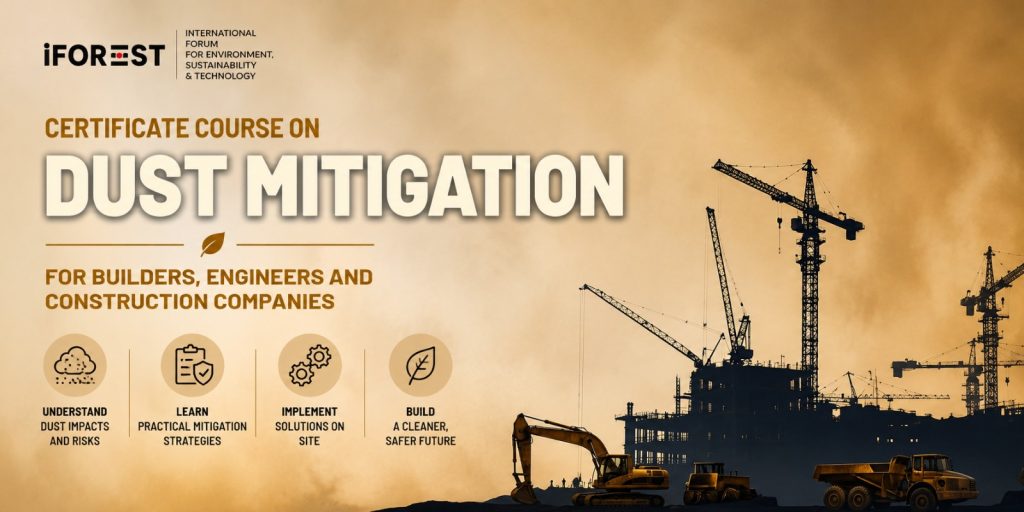
Dust Mitigation Training Course
For Builders, Engineers & Construction Companies
Building safer, cleaner construction sites through practical training on dust management, compliance, monitoring and on-ground action planning.
About the training program
Construction activities are among the leading contributors to urban air pollution in India. Dust from sites, including PM10, PM2.5, silica and cement particles, poses serious health risks to workers and communities, and drives non-compliance with national standards.
This intensive programme, developed by iFOREST, gives construction professionals the knowledge, tools and practical skills to manage and mitigate dust from regulatory compliance to on-ground action planning.
The 5D training approach
Define
Key objectives, learning plan and milestones.
Design
Structured sessions, interactive exercises and simulations.
Deliver
Expert-led sessions, case studies and role plays.
Discuss
Facilitated groups, site assessments and Q&A panels.
Document
Study materials, MCQ tests and certification.
Physical training includes
- Case studies
- Role plays
- Mock site hazard walks
- Self assessments
- Rapid quiz rounds
- Group exercises
- Presentations
- Team building
- Gallery walks
- Written evaluations
- Panel discussions
- Action planning
Topics covered
Roles & Context
- Types, sources and dispersion pathways
- Regulatory framework and national standards
- CPCB norms and compliance obligations
- Organisational roles and responsibilities
- Documentation and reporting
- Environmental damage assessment
Tools & Controls
- Mitigation hierarchy and control selection
- Barriers, netting and perimeter enclosures
- Air quality monitoring instruments
- Dust mitigation plan development
- Water suppression and on-tool extraction
- Designing a site monitoring network
Skills & Technology
- Data interpretation and visualization
- Site risk profiling and assessment
- PPE selection and health surveillance
- Digital tools and IoT sensor networks
- Green and bio-suppressant solutions
- AI-based prediction and drone monitoring
Who should attend?
Site & Project Engineers
On-site professionals responsible for operations and dust control implementation.
Project Managers
Leaders managing activities, timelines and contractor compliance.
Health & Safety Officers
Professionals overseeing OELs, PPE selection and worker health protocols.
Construction Companies
Organisations reducing regulatory risk and improving site performance.
Contractors & Sub-contractors
Ground teams implementing dust mitigation measures on a daily basis.
Environmental Managers
Specialists managing EIA compliance and air quality monitoring.
Format highlights
Classroom + Hands-On
Practical learning designed for real site application.
Certified Programme
Includes evaluation support and certification pathway.
24×7 Virtual Platform
Ongoing access to supporting digital learning resources.
Expert-Led Sessions
Sessions guided by subject matter specialists.
For further details
Website: www.iforest.global
Email: info@iforest.global
Headquarters: C – 902, 9th Floor, Urbtech Trade Centre Noida Expressway, 35, B Block, Sector – 132, Noida – 201304, Uttar Pradesh
Course Assessment and Certification
Each course is divided into multiple modules, and participants are required to complete a short assessment at the end of every module before proceeding to the next one. A minimum score of 75% is mandatory to unlock the subsequent module. Participants who do not achieve the required score will need to reattempt the assessment.
Upon completion of all modules, participants will be required to undertake a final online assessment for the course. Participants securing 80% or above in the final assessment will be awarded a course completion certificate.
Please note that only two attempts will be provided for the final assessment. Participants are therefore encouraged to carefully go through the course content and take the assessments seriously.
Course Content
- Module-1. Introduction to Types of Dust Emissions This module sets the foundation by explaining why dust is a major urban air-quality problem in India, especially in rapidly growing and construction-intensive cities. It introduces key dust categories such as TSP, PM10, PM2.5, ultrafine particles, black carbon, and mineral dust, and links them to major Indian sources like road resuspension, construction activity, barren land, riverbanks, and dust storms. It also highlights the scale, seasonal patterns, and economic and social costs of dust pollution, helping learners understand dust as both an environmental and public health challenge.
Enroll to access this lesson.
- Module 2: Dust Generation in Construction Sites This module explains how construction dust is created, what it contains, and why it behaves differently depending on particle size, activity type, and site conditions. It covers the main sources of construction dust such as demolition, material handling, cutting, grinding, drilling, earthworks, and vehicle movement, and classifies major dust types including respirable crystalline silica, wood dust, and nuisance dust. It also introduces dispersion pathways and the factors that influence how dust travels, settles, and gets re-suspended, giving participants a practical understanding of dust risks on active sites.
Enroll to access this lesson.
- Module 3: Existing Dust Mitigation Regulation This module provides the legal and regulatory context for dust management, showing that dust control is both a health necessity and a compliance obligation. It reviews the international framework through WHO, ILO, OSHA, EPA, EU, UK HSE, and ISO references, and then maps the Indian regulatory structure involving constitutional duties, central laws, CPCB guidelines, SPCBs, CAQM, NGT, and local bodies. By connecting standards, exposure limits, and enforcement systems, the module helps construction professionals understand what compliance requires and why regulatory awareness is essential for site management.
Enroll to access this lesson.
- Module 4: Dust Mitigation Plan Development This module focuses on how to create a structured, site-specific Dust Mitigation Plan that translates compliance requirements into day-to-day action. It explains the purpose and core components of a DMP, including source identification, control objectives, mitigation measures, monitoring, reporting, emergency response, documentation, and training. It also walks through a practical five-step approach—procure, train, maintain, monitor, and review—along with roles, KPIs, trigger points, implementation roadmap, and common failure points, making it a hands-on planning module for project teams.
Enroll to access this lesson.
- Module 5: Dust Management and Control Options This module introduces the hierarchy of dust control measures, with a strong emphasis on engineering controls as the primary line of defence before administrative measures or PPE. It covers suppression systems such as misting, fogging, anti-smog guns, and sprinklers; capture systems such as on-tool extraction, LEV, downdraft tables, and HEPA vacuums; and containment methods such as hoardings, chutes, covers, and negative-pressure enclosures. It also expands into housekeeping, scheduling, staff training, green bio-suppressants, IoT-enabled monitoring, drones, cost-benefit analysis, and phased implementation, giving learners a broad toolbox for selecting practical site controls.
Enroll to access this lesson.
- Module 6: Case Studies and Best Practices
Enroll to access this lesson.
- Module 7: Construction & Demolition Waste Management Rules of India, 2025/2026 This module explains the revised C&D Waste Management Rules and why they matter for both waste governance and dust reduction. It traces the shift from the 2016 framework to the stronger 2025 rules, highlighting key changes such as Extended Producer Responsibility, digital compliance through the CPCB portal, recycling targets, utilization mandates, traceable transport, infrastructure requirements, and stricter enforcement. It helps learners understand how proper C&D waste handling reduces illegal dumping, limits secondary dust emissions, and creates a more circular and accountable construction system.
Enroll to access this lesson.
- Module 8: Exposure and Workers Safety This module centers on worker health by explaining what exposure means, how construction dust enters the body, and why chronic exposure can silently lead to irreversible disease. It covers acute, chronic, and cumulative exposure; key dust types such as silica, asbestos, cement, wood, gypsum, and chemical dust; exposure limits; health effects; and the hierarchy of control from elimination to PPE. It also addresses fit-for-purpose respiratory protection, correct PPE use, health surveillance, worker training, and responsibilities across managers, safety officers, contractors, and workers, making it the core occupational safety module of the course.
Enroll to access this lesson.
- Module 9: Monitoring, Evaluation and Verification in Dust Mitigation This module explains how dust control must be measured and verified after installation to remain effective over time. It covers the regulatory framework for monitoring, defines the roles of site engineers, urban local bodies, and pollution control boards, and details daily checks, record-keeping, inspections, monitoring tools, evaluation metrics, and escalation procedures for non-compliance. By focusing on evidence-based oversight, data reporting, audits, and verification protocols, the module shows how sites can demonstrate actual dust reduction rather than just nominal compliance.
Enroll to access this lesson.
Instructor

Share this Course